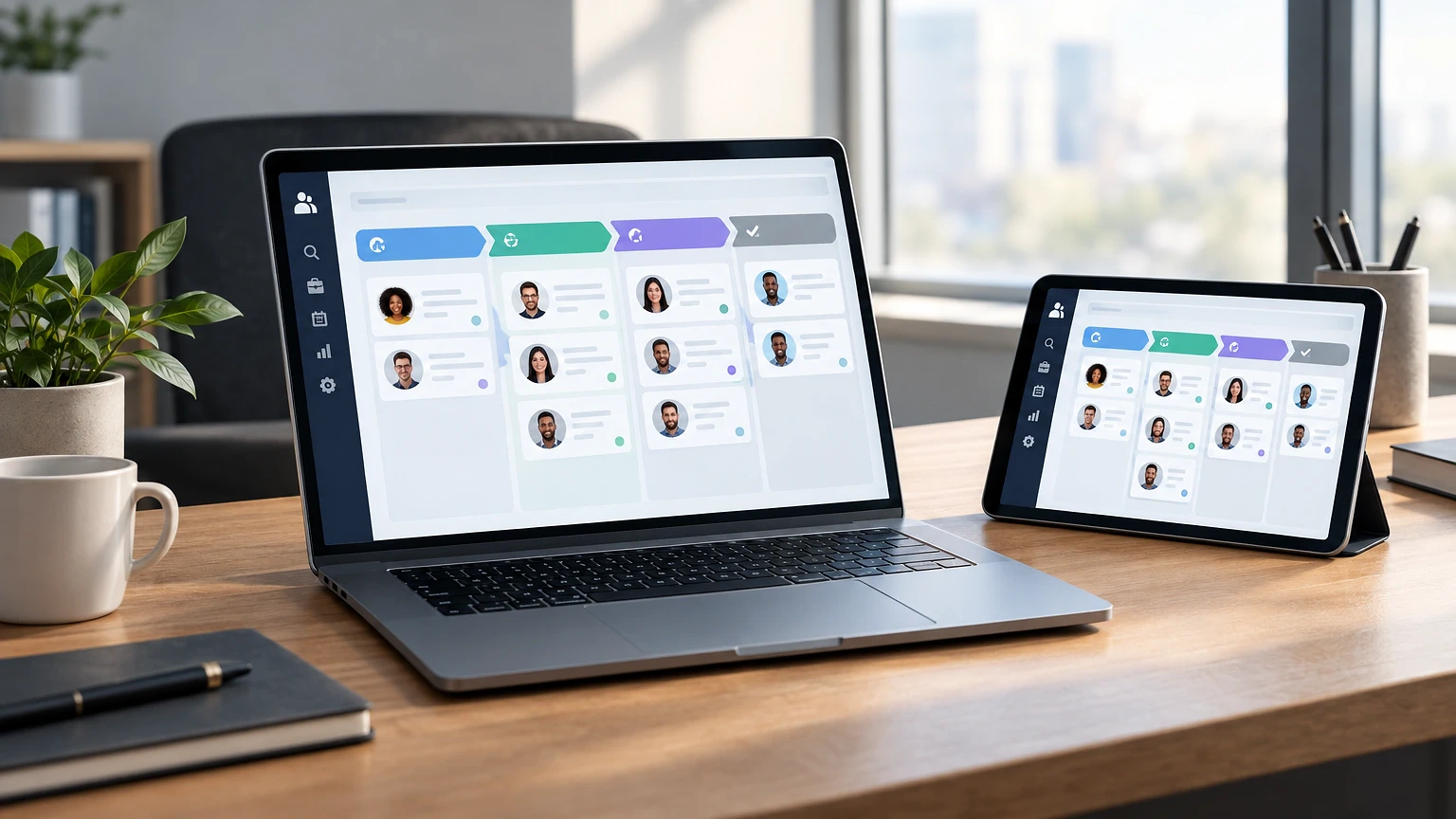
Here’s a number that should worry you: candidates drop out of hiring processes constantly when the experience feels clunky or slow. The talent acquisition software you pick for sourcing, screening and scheduling either smooths that path or adds friction at every step.
Talent acquisition software isn’t just a fancier applicant tracker. It’s the system that decides whether your best candidate hears back in two days or two weeks. This guide breaks down what these platforms actually do, what they cost, and which ones fit which teams.
What Talent Acquisition Software Actually Does
Most people lump an ATS (applicant tracking system) and talent acquisition software together. They’re related, but not identical.
An ATS tracks applicants through a pipeline: applied, screened, interviewed, offered. Talent acquisition software does that plus sourcing, candidate relationship management (CRM), employer branding, and often onboarding. Think of the ATS as one module inside a bigger engine.
Picture a mid-size company hiring for 15 open roles at once. Without a proper system, recruiters juggle spreadsheets, email threads, and sticky notes about who said what in a phone screen. With talent acquisition software, every interaction lives in one record. A hiring manager can see candidate history, interview notes, and scorecards without pinging the recruiter for a status update.
The practical test: can your team answer “where is this candidate right now, and who owns the next step” in ten seconds? If not, the tooling is the bottleneck, not your people.
How to Evaluate a Platform Before You Buy
Don’t start with feature lists. Start with your hiring volume and your pain point.
If you’re hiring under 20 roles a year, you need something simple that won’t require a dedicated admin. If you’re running 100+ requisitions across multiple countries, you need workflow automation, integrations with your HRIS (Human Resources Information System), and reporting that satisfies a board, not just a hiring manager.
Ask vendors these questions during a demo:
- How long does implementation take, and who does the data migration?
- Can I customize interview scorecards per role, not just globally?
- What does the candidate-facing experience look like on mobile?
- Which integrations are native versus built through a third-party connector?
- How is DE&I (diversity, equity and inclusion) reporting handled, and can I export raw data?
A vendor who dodges question five is worth noting. Reporting gaps there usually mean the data structure wasn’t built with equity analysis in mind from day one.
Comparing Two Common Buying Paths
Teams generally land in one of two camps when shortlisting. Here’s how each plays out.
Option A: All-in-One Suite
You pick one platform that handles sourcing, ATS, CRM and onboarding together. SmartRecruiters and iCIMS both fit this model, built for organizations that want a single system of record across the entire hiring lifecycle.
The upside: one login, one data source, fewer integration headaches. The downside: you’re locked into one vendor’s roadmap, and if their onboarding module is weaker than a standalone tool, you live with it anyway.
Option B: Best-of-Breed Stack
You choose a strong ATS, then bolt on separate tools for sourcing, assessments, and onboarding. Lever works well here since LeverTRM combines ATS and CRM natively, reducing how many extra tools you need to stitch in.
The upside: you pick the best tool for each job. The downside: more vendor relationships to manage, and integration breakage is your problem to fix, not theirs.
Neither path is wrong. Smaller teams usually do better with Option A because nobody has time to manage five vendor contracts. Larger talent acquisition functions with dedicated ops staff often prefer Option B for the control it gives them.
Six Platforms Worth Shortlisting
Here are six tools that come up constantly in talent acquisition conversations, each suited to a different hiring profile.
- Greenhouse – built for mid-market to enterprise teams that want structured, data-driven hiring. Greenhouse offers interview kits, scorecards, and integrates with 500+ HR tech partners through an open API. Pricing on request. It fits poorly for a five-person startup that just needs to post a job and track three applicants; the structure becomes overhead rather than help.
- Lever – strong for growing and enterprise teams that want sourcing and tracking in one place. Native integrations with Workday and BambooHR make it a smooth fit if you already run those systems. Pricing on request. It’s a weak match for teams with very low hiring volume, where the CRM nurture features go unused.
- Workable – aimed at small and mid-sized businesses wanting an all-in-one platform. Workable includes AI-powered sourcing from a pool of hundreds of millions of candidate profiles, one-click posting to 200+ job boards, and built-in video interviews. Pricing on request. It tends to feel underpowered for large enterprises running complex, multi-region approval chains.
Three More Talent Acquisition Software Options To Weigh
- iCIMS – built for large enterprises with high-volume, global hiring needs. The Talent Cloud bundles ATS, CRM and onboarding, with a marketplace of 450+ integrations and AI-driven candidate matching. Pricing on request. Small businesses usually find it too heavy, both in cost structure and implementation time.
- SmartRecruiters – an end-to-end suite for enterprise organizations wanting sourcing, CRM, ATS and onboarding under one roof. SmartRecruiters has an open marketplace with hundreds of vetted integrations and mobile-friendly scheduling. Pricing on request. It’s overkill for a startup making its first five hires.
- JazzHR – the pick for small businesses and startups wanting an affordable, fast-to-deploy ATS. JazzHR covers customizable workflows, automated posting to boards like Indeed and ZipRecruiter, and dashboards for time-to-fill and source-of-hire. Pricing on request. Enterprise teams will outgrow it quickly once hiring volume or compliance complexity rises.
Comparing the Shortlist Side by Side
| Platform | Best Fit | Pricing | Poor Fit For |
|---|---|---|---|
| Greenhouse | Mid-market to enterprise, structured hiring | Pricing on request | Very small teams with low hiring volume |
| Lever | Growing to enterprise teams needing ATS + CRM | Pricing on request | Teams with minimal sourcing needs |
| Workable | Small to mid-sized businesses | Pricing on request | Large enterprises with complex workflows |
| iCIMS | Large enterprises, global hiring | Pricing on request | Small businesses, limited budgets |
| SmartRecruiters | Enterprise, end-to-end suite | Pricing on request | Startups with few open roles |
| JazzHR | Startups and small businesses | Pricing on request | Enterprises with high compliance needs |
None of these vendors publish list pricing publicly, which is standard in this market since contracts scale with seat count, modules, and hiring volume. Get quotes from at least three before you sign anything, and ask specifically what happens to your price at renewal.
Rolling Out New Software Without Losing Your Team
The tool matters less than the rollout. A platform switch mid-hiring-season can tank your time-to-fill numbers if you don’t plan it.
Here’s a workplace situation that plays out often: a company signs a new ATS contract in Q1, expecting it live within two weeks, right as they’re trying to fill 20 roles. Recruiters end up running two systems in parallel, candidate data gets duplicated, and a few applicants fall through the cracks entirely. The fix isn’t a better tool. It’s a better timeline.
Before go-live, migrate historical candidate data with a clear cutoff date. Don’t let old and new systems run in parallel longer than two weeks. Train hiring managers on the new scorecard format before their first interview in the new system, not during it. And keep a single source of truth for “which system is live” so nobody emails a candidate’s resume through an abandoned tool.
If you’re mid-hiring-season, consider delaying the switch until your busiest sourcing window closes. A software upgrade shouldn’t come at the cost of candidates ghosted because nobody checked the right inbox.
Getting the Most From Whatever You Choose
The best talent acquisition software in the world won’t fix a broken interview process. It organizes what’s already there. If your scorecards are inconsistent or your hiring managers skip feedback, the software will just make those gaps visible faster.
Treat the buying decision as a two-part problem: pick a platform that fits your volume and structure, then fix your process alongside it. Build real interview kits. Define what “good” looks like for each role before you open requisitions. Train hiring managers to leave structured feedback within 24 hours, not whenever they remember.
Whichever platform you land on, from JazzHR’s simplicity to iCIMS’s enterprise depth, the real return comes from how consistently your team uses it, not from the feature list on the sales deck.
Frequently asked questions
What’s the difference between an ATS and talent acquisition software?
An ATS tracks candidates through your hiring pipeline. Talent acquisition software is broader, often including sourcing tools, CRM for nurturing passive candidates, employer branding features, and onboarding. Many modern platforms, like Lever and SmartRecruiters, bundle both under one roof.
How much does talent acquisition software typically cost?
Pricing varies by vendor and is usually quote-based, scaling with seat count, hiring volume, and which modules you need. None of the major platforms, including Greenhouse, Workable, and iCIMS, publish list prices publicly, so getting multiple quotes is standard practice before committing.
Can small businesses use enterprise-grade platforms like iCIMS or SmartRecruiters?
Technically yes, but it’s rarely a good fit. These platforms are built for high-volume, complex hiring with dedicated recruiting ops staff. A small business with a handful of open roles usually gets more value from a lighter tool like JazzHR or Workable.
How long does it take to implement new talent acquisition software?
Implementation time depends on data migration complexity and how many integrations you need. Simpler platforms can go live in days; enterprise suites with HRIS integrations and custom workflows often take weeks. Always confirm the vendor’s implementation timeline before signing, especially if you’re mid-hiring-season.
Does talent acquisition software help with diversity hiring?
Many platforms include DE&I reporting features, letting you track where candidates drop off by demographic stage. Greenhouse is known for strong analytics here. That said, the software only reports what you measure, so your interview process and job descriptions still need separate attention.
Pricing verified 2026-10-04. Check the vendor site for the latest.