
Most managers write “needs improvement” and stop there. That’s the mistake. Useful areas of improvement name the behavior, show the gap with a real moment, and point to one next step.
Good areas of improvement performance review examples name the behavior, show the gap with a real moment, and point to a specific next step. This piece gives you copyable language for the most common gaps, plus a quick read on the software that can take the drafting grind off your plate.
Why Vague Feedback Backfires in Reviews
Vague areas of improvement create confusion, not change.
Tell someone “communication needs work” and they’ll guess at what you mean. Most guess wrong.
Compare these two lines. “Needs to communicate better with the team” versus “In the Q3 product launch, the marketing team found out about the delayed ship date two days after engineering knew. Going forward, flag timeline changes in the #launches Slack channel within 24 hours.” The second version gives a date, a channel, and a deadline. The employee knows exactly what success looks like next time.
This matters for legal reasons too, not just coaching ones. If a performance issue ever factors into a termination or a pay decision, vague write-ups are weak evidence. Specific, dated, behavior-based notes hold up far better. Employment rules on documentation and disciplinary process vary by state and country, so confirm your write-up standards with employment counsel rather than treating this article as legal guidance.
A good template separates the observation from the impact from the ask. Observation: what happened, when. Impact: what it cost the team, client, or deadline. Ask: the one change you want to see by the next check-in. Skip any of the three and the feedback gets softer, and softer feedback gets ignored.
Copyable Phrasing for Common Areas of Improvement
Here are ready-to-use phrasings for the gaps that show up most in review cycles. Swap in names, dates, and specifics before you send them.
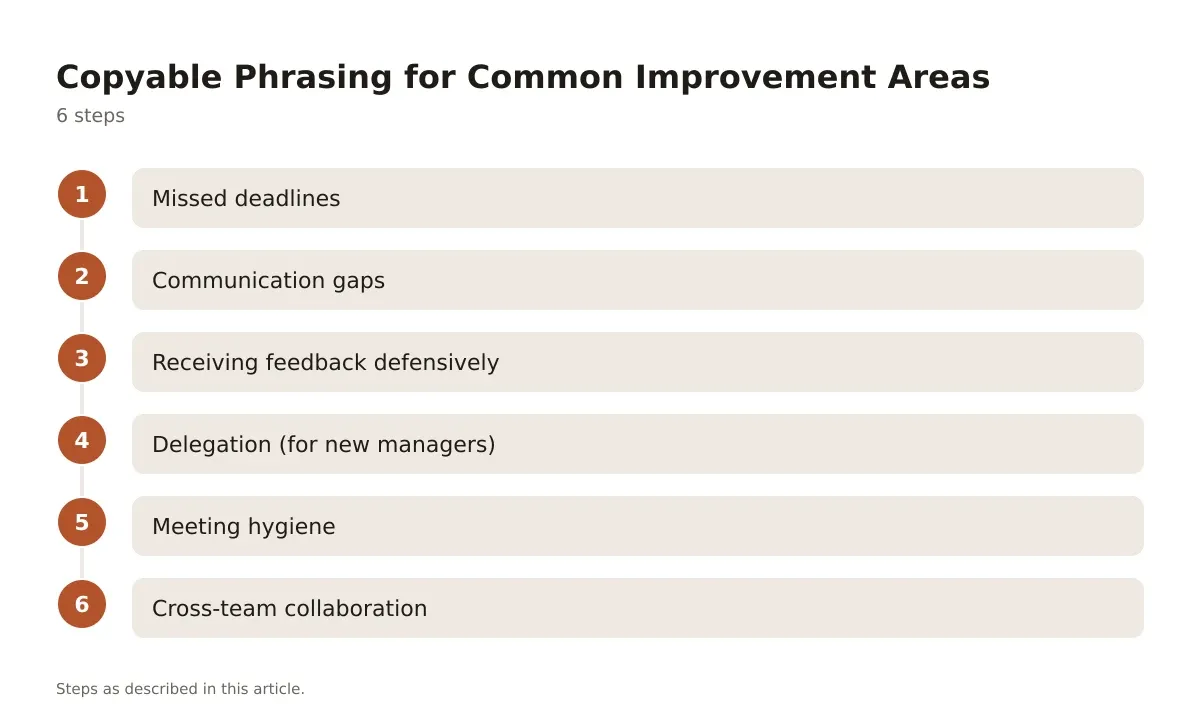
- Missed deadlines: “You delivered 3 of the last 5 sprint commitments on time. For the next cycle, flag blockers in standup the day you spot them, not the day the deadline passes.”
- Communication gaps: “Stakeholders on the Henderson account said they had to chase you for status updates twice this quarter. Send a Friday recap email to the account team, even a two-line one, every week.”
- Receiving feedback defensively: “In our last two 1:1s, you explained why the critique didn’t apply before we finished discussing it. Try writing the feedback down first and responding the next day instead of in the moment.”
- Delegation (for new managers): “You’re still writing the first draft of every deliverable your team produces. Pick one recurring task this month and hand the first draft to a direct report, even if it’s rougher than yours.”
- Meeting hygiene: “Three of your last five team meetings ran over by 15+ minutes with no agenda shared beforehand. Send an agenda 24 hours ahead and end on time, even if items roll to next week.”
- Cross-team collaboration: “Engineering flagged that design specs arrive without edge cases noted, which causes rework. Add a ‘known gaps’ section to each spec before handoff.”
Notice none of these say “be better at X.” Each one names a specific instance and a specific fix. That’s the difference between feedback people can act on and feedback that just stings.
Setting Timelines for Areas of Improvement
A goal without a date is a wish, not a plan.
When you write an improvement area into a review, attach a check-in date, not just a vague “going forward.” Thirty, sixty, and ninety-day windows work well because they’re short enough to stay top of mind and long enough to show real change.
For a deadline-related gap, a 30-day check-in might sound like: “Let’s revisit this in our October 15 1:1. I want to see two sprints in a row where you flagged blockers early.” For something slower to shift, like delegation skill or cross-team communication habits, 90 days gives more realistic runway.
Put the date in the written review, not just said aloud in the meeting. Verbal commitments get forgotten; calendar invites don’t. If you use a tool like Lattice or 15Five, most let you set a follow-up reminder tied to the goal, so it resurfaces automatically instead of relying on your memory three months from now.
One caution: don’t stack five areas of improvement with five different deadlines in a single review. Pick one, maybe two, that matter most. Employees who get a laundry list of growth areas tend to improve on none of them, because nothing feels like the priority.
Handling Pushback From the Employee
Some employees will disagree with your assessment, and that’s not automatically a problem.
If someone says “I didn’t know that was expected,” take it seriously. Check whether the expectation was ever written down, in an onboarding doc, a role scorecard, or a past 1:1 note. If it wasn’t, that’s partly on the documentation, and the review should reflect a forward-looking standard rather than retroactive blame.
If the employee disagrees with the facts, not just the framing, ask for specifics. “Walk me through the Henderson account timeline from your side.” Sometimes you’ll learn a dependency you missed. Sometimes you’ll confirm the original read was right. Either way, you want the conversation on record, even briefly, in the written review notes.
Avoid the trap of softening the write-up just to end the disagreement quickly. If you downgrade “missed three deadlines” to “could improve time management” because the meeting got tense, you’ve lost the specificity that made the feedback useful in the first place. Hold the line on facts; be flexible on tone.
Linking Areas of Improvement to Pay and Promotion Decisions
This is where reviews get legally sensitive, so tread carefully.
If an improvement area from six months ago factors into a denied raise or a passed-over promotion, you need a paper trail connecting the two. That means the original review stated the gap clearly, gave a timeline, and documented whether the person met it. Without that chain, a pay or promotion decision can look arbitrary, or worse, discriminatory, even when it isn’t.
This is squarely a topic to run past your employment lawyer or HR counsel, because rules on pay transparency, documentation retention, and adverse action vary significantly by state and country. What’s standard practice in Texas may not hold up in California, and what works in the US may not translate to UK or EU employment law at all. Nothing here should be read as a compliance ruling for your specific situation.
What you can control is consistency. If one manager’s reviews are detailed and dated while another’s say “doing fine, keep it up,” calibration sessions across teams help close that gap. Culture Amp and Betterworks both build calibration workflows specifically so reviews read consistently across the organization, which matters more than people think when a PIP or compensation decision gets questioned later.
Software That Helps You Draft Better Review Language
Writing specific, well-dated feedback for ten or twenty direct reports every cycle is genuinely hard work. The right tool won’t write the feedback for you, but it can speed up the drafting and keep the structure consistent.
Software Shortlist for Areas of Improvement Feedback
Quick picks:
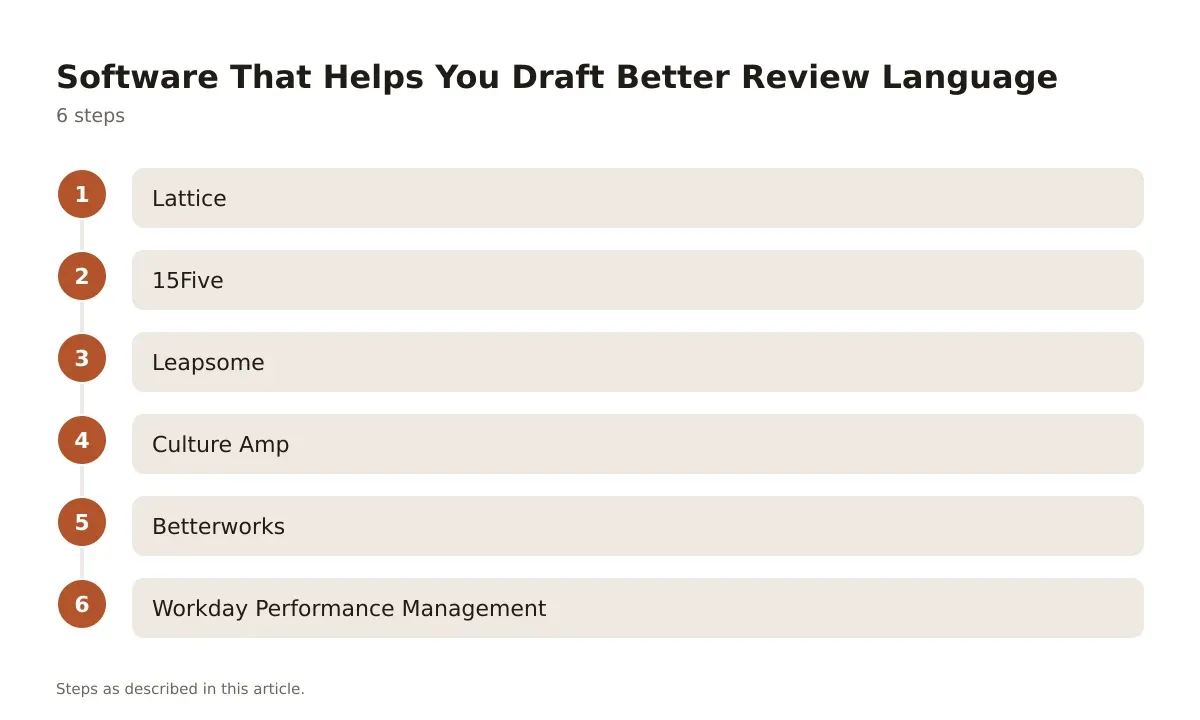
- Lattice – best all-in-one for mid-size to large teams, AI drafting support included – Pricing on request
- 15Five – best for pairing weekly check-ins with formal reviews – Pricing on request
- Leapsome – best for tech companies wanting performance plus learning in one suite – Pricing on request
- Culture Amp – best for data-backed, bias-checked review language – Pricing on request
- Betterworks – best for enterprises tying goals directly into review conversations – Pricing on request
- Workday Performance Management – best for large enterprises already on Workday HCM – Pricing on request
Lattice combines reviews, 360-degree feedback, OKR tracking, and engagement surveys in one platform, with AI-assisted writing support that helps managers turn a rough note into review-ready language. It integrates with Gusto, BambooHR, ADP, Slack, and Microsoft Teams. It fits badly for a five-person startup that just needs a simple annual review form; the feature set is built for larger, more structured HR functions.
15Five pairs weekly check-ins with its “Best-Self Review” competency model and offers AI-generated summaries to help managers draft faster. It fits badly for companies that already run a heavy cadence of 1:1s elsewhere and don’t want another check-in tool layered on top.
Leapsome bundles performance reviews, OKRs, 360 feedback, and an LMS, plus a compensation module tied to review outcomes. It fits badly for non-tech companies with simpler org structures, since much of its value shows up in fast-growing, goal-heavy teams.
Analytics-Led and Enterprise Options
Culture Amp leans into people analytics, with bias-detection built into its review templates and benchmarking against industry survey data. It fits badly for small teams without a dedicated people-analytics function to act on the data it produces.
Betterworks ties goal-setting directly into the review conversation and gives managers conversation guides and coaching prompts. It fits badly for companies without mature OKR practices already in place, since the tool assumes that structure exists.
Workday Performance Management lives inside the broader Workday HCM suite, which makes it strong for large enterprises already on that platform. It fits badly for any company not already using Workday for core HR, since standalone adoption rarely makes sense.
| Tool | Best for | Price |
|---|---|---|
| Lattice | All-in-one performance + engagement | Pricing on request |
| 15Five | Check-ins plus formal reviews | Pricing on request |
| Leapsome | Performance + learning + comp | Pricing on request |
| Culture Amp | People analytics and benchmarking | Pricing on request |
| Betterworks | Goal-linked enterprise reviews | Pricing on request |
| Workday Performance Management | Native Workday HCM shops | Pricing on request |
Getting Review Language Right Every Cycle
The pattern across every section here is the same: specific beats vague, every time. A dated observation with a clear ask does more for an employee’s growth, and for your legal footing, than any well-meaning but fuzzy phrase ever will.
If you’re building out a library of phrasing for your next review cycle, start with the gaps that show up most on your team, missed deadlines, communication, delegation, and write two or three versions of each so managers aren’t starting from a blank page. For a broader set of ready-to-use phrasing across performance levels, the performance review examples managers actually use is worth keeping open while you draft.
Software can speed up the writing and keep formatting consistent across managers, but it can’t replace the manager actually knowing what happened on the Henderson account or in last week’s sprint. Pick the tool that matches your company’s size and existing HRIS, not the one with the longest feature list.
Pricing verified 2026-10-11. Check the vendor site for the latest.
Frequently asked questions
What should an area of improvement in a performance review actually include?
A strong one names the specific behavior, a dated instance of it happening, the impact it had, and a clear next step with a timeline. Avoid generic phrases like “needs to improve communication” without an example attached. The goal is that the employee could read it alone and know exactly what to change.
How many areas of improvement should go in one review?
Most reviews work better with one or two priority areas rather than a long list. Employees who receive five or six growth areas at once tend to act on none of them, since nothing reads as the clear priority. Save secondary notes for an ongoing 1:1 log instead of cramming them into the formal review.
Can areas of improvement be used to justify denying a raise?
They can, but only if the original review documented the gap clearly, with a timeline and a follow-up check on whether it was met. Rules on pay decisions and required documentation vary by state and country, so this is a question for your employment counsel, not a general policy answer. Weak or vague documentation tends to create more legal exposure, not less.
Do performance review software tools write the feedback for me?
Tools like Lattice and 15Five offer AI-assisted drafting that can turn rough manager notes into more polished review language, but they work from what you give them. You still need to supply the specific instance, date, and impact; the software mainly helps with structure and phrasing speed. None of the tools listed here replace a manager’s firsthand knowledge of what actually happened.
How often should areas of improvement be revisited after the review?
Thirty, sixty, or ninety days is a common range, depending on how quickly the skill can realistically shift. Deadline and communication habits often show change within 30 days; something like delegation or cross-team collaboration usually needs closer to 90. Put the follow-up date in writing in the review itself, not just mentioned verbally in the meeting.