
Only 21% of employees worldwide were engaged at work in 2024, according to Gallup’s State of the Global Workplace report. That number barely moved despite companies spending heavily on employee engagement tools meant to fix it.
Employee engagement tools aren’t the problem. How people pick and run them usually is. This piece walks through what actually works, what doesn’t, and what each platform costs per employee so you’re not guessing.
Why Most Employee Engagement Tools Fail Before Launch
Here’s a scenario you’ve probably lived through. A company rolls out a shiny new platform, sends a launch email, and three months later nobody’s touched it except HR.

That happens because the tool got picked to solve a leadership headache, not an employee one. If managers can’t explain in one sentence why staff should care, adoption dies fast.
The fix is boring but it works: pilot with one team for four weeks before a company-wide rollout. Ask that team directly: “Did this change anything about your week?” If the answer is a shrug, don’t scale it.
Tools like Culture Amp and Lattice both recommend a manager-training session before launch, not after. Skip that step and you’ll spend the next two quarters explaining why response rates are sitting at 30%.
How Employee Engagement Tools Differ: Surveys, Recognition, and All-in-One Suites
Engagement software splits into three rough categories, and conflating them is where a lot of budgets get wasted.
Survey and pulse tools measure sentiment. Recognition platforms reward behavior in the moment. All-in-one suites try to do both plus performance reviews and goal tracking.
A 40-person startup rarely needs the third category. A 2,000-person company running quarterly reviews, pulse surveys, and peer recognition separately is probably paying for three logins when one platform could cover it.
The honest question to ask before buying anything: what decision will this data actually drive? If you can’t name the decision, you don’t need the dashboard yet. For teams still figuring out their baseline, our guide on how to improve employee engagement without a survey fetish covers what to measure before you buy anything.
Comparing the Leading Employee Engagement Tools
Culture Amp
Culture Amp is built for people-analytics teams that want benchmarking against industry data. Pricing is quote-based and scales with headcount, with most mid-market deals landing in the five-figure annual range. It fits companies with a dedicated People team poorly suited to a solo HR generalist trying to self-serve setup, since the survey-design options can overwhelm a first-time admin.
Lattice
Lattice bundles performance reviews, goal-setting, and engagement surveys into one system. It’s priced per employee per month, with engagement as an add-on module to the core performance product. It fits badly for companies that only want pulse surveys, since you’ll pay for performance-management features you may not use.
15Five
15Five focuses on weekly check-ins and manager coaching prompts alongside engagement scoring. It’s priced per employee per month on tiered plans. It fits poorly in highly matrixed organizations where employees report to multiple managers, since the check-in structure assumes one clear manager relationship.
Officevibe
Officevibe, part of Officevibe by Workleap, leans toward lightweight pulse surveys and anonymous feedback channels. Pricing is per-employee per month and generally lower-cost than full suites. It fits badly for companies wanting deep performance-review integration, since that’s not its core function.
Bonusly
Bonusly is a peer-recognition tool built around small point-based rewards redeemable for gift cards or donations. It’s priced per employee per month. It fits poorly for organizations that need survey or sentiment data, since recognition is its whole focus, not measurement.
| Tool | Best for | Pricing model | Poor fit for |
|---|---|---|---|
| Culture Amp | Benchmarked surveys, people analytics | Quote-based, scales with headcount | Small teams without a People function |
| Lattice | Performance + engagement combined | Per employee/month, tiered | Teams wanting engagement only |
| 15Five | Manager check-ins, coaching | Per employee/month | Matrixed reporting structures |
| Officevibe | Lightweight pulse surveys | Per employee/month | Deep performance-review needs |
| Bonusly | Peer recognition | Per employee/month | Sentiment or survey measurement |
A Rollout Checklist for Employee Engagement Tools
Before you sign a contract, run through this list with whoever owns the budget.
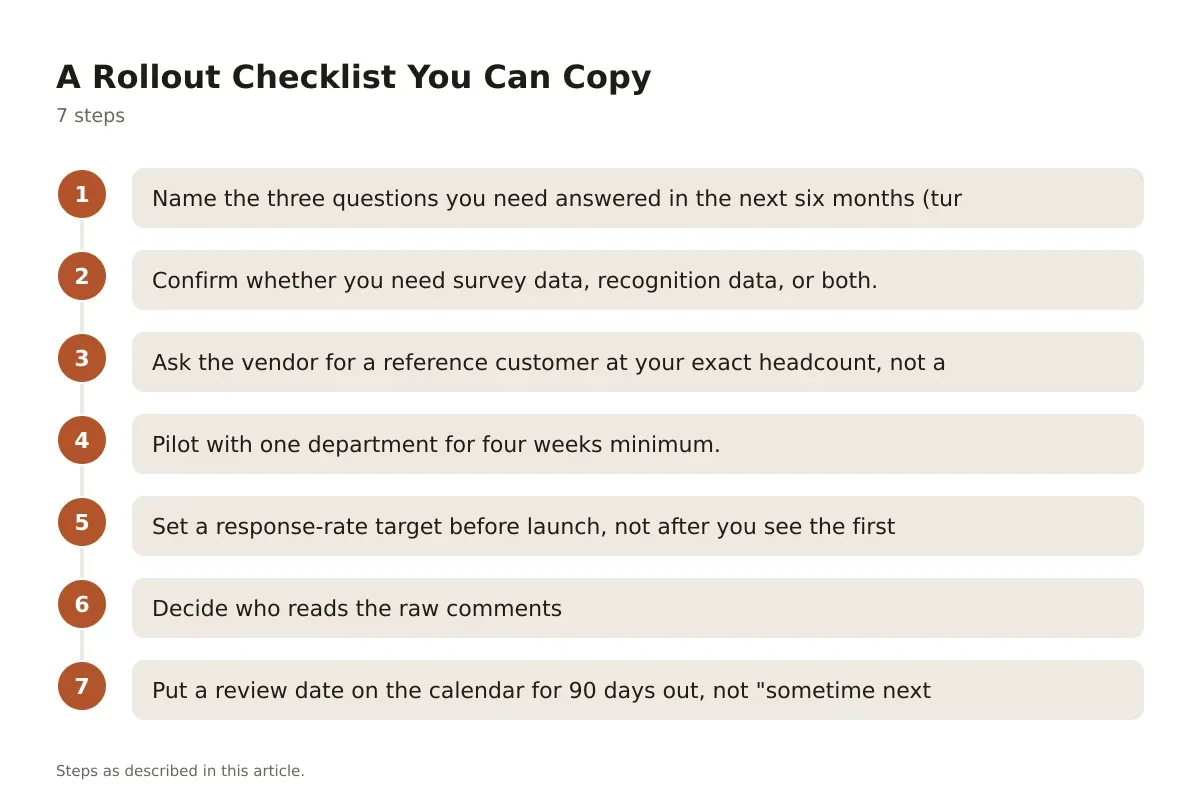
- Name the three questions you need answered in the next six months (turnover risk, manager effectiveness, onboarding friction).
- Confirm whether you need survey data, recognition data, or both.
- Ask the vendor for a reference customer at your exact headcount, not a company ten times your size.
- Pilot with one department for four weeks minimum.
- Set a response-rate target before launch, not after you see the first result.
- Decide who reads the raw comments. Anonymity breaks fast if managers can guess who wrote what.
- Put a review date on the calendar for 90 days out, not “sometime next year.”
Skipping step six is the most common mistake. Employees stop writing honest feedback the moment they suspect it’s traceable back to them.
Writing Survey Questions People Actually Answer Honestly
Generic questions get generic answers. “Do you feel valued at work?” invites a polite lie.
Try something more specific instead:
Copyable question: “In the last two weeks, did your manager acknowledge a specific piece of work you did? Yes / No / Unsure.”
That’s behavioral, not emotional. It’s harder to fake and easier to act on.
Another one worth stealing:
Copyable question: “If you were offered a similar role elsewhere tomorrow, what’s the one thing that would make you stay?”
Open-ended, but anchored to a real decision point rather than abstract satisfaction. If you’re building a full survey from scratch, our breakdown of what actually works in an employee engagement survey has more question templates organized by what they’re meant to reveal.
Keep surveys under 15 questions. Response rates drop sharply past that point, and the data from question 20 onward tends to be rushed and unreliable anyway.
Turning Engagement Data Into Manager Conversations
The dashboard is not the deliverable. The conversation it triggers is.
Picture a manager who gets a report showing their team’s engagement score dropped eight points. Without guidance, that manager either panics or ignores it.
Give managers a script instead of a spreadsheet. Something like: “Your team flagged lower clarity on priorities this quarter. In your next 1:1s, ask each person: ‘What’s one thing you’re not sure you should be working on right now?'” That’s a question they can ask today, not a metric they have to interpret alone.
Platforms like Lattice and 15Five both push manager-facing nudges automatically, which helps, but the nudge still needs a human translation layer. HR should review flagged scores with managers before those managers see raw comments, so the conversation starts calm instead of defensive. For broader context on why some engagement pushes stick and others don’t, see our piece on employee engagement strategies that hold up under pressure.
Making Your Employee Engagement Tools Hold Up Over Time
Tools don’t fix engagement. They surface what’s already true and give you a faster way to respond to it.
The companies that get value from these platforms treat the data as a starting point for a conversation, not a scorecard to defend in a board meeting. They pick one or two metrics that matter to their specific business, not every metric the vendor’s dashboard offers by default.
If you’re choosing a platform this quarter, start smaller than you think you need. A focused pulse tool with high response rates beats an all-in-one suite nobody opens.
Frequently asked questions
What’s the difference between employee engagement tools and performance management software?
Engagement tools measure sentiment, motivation, and feedback, usually through pulse surveys or recognition features. Performance management software tracks goals, reviews, and output against targets. Some platforms, like Lattice, combine both, but that’s a bundling choice, not proof the two concepts are the same thing.
How often should we run engagement surveys?
Quarterly pulse surveys work for most companies, with a deeper annual survey for benchmarking. Running surveys monthly often causes fatigue and declining response rates. Match frequency to how fast your organization actually changes, not to what the vendor’s default cadence suggests.
Can small companies skip engagement software entirely?
Yes, under roughly 50 people, a shared document and regular 1:1s can capture most of what a platform would show you. The tools earn their cost once headcount makes manual tracking unreliable, typically past 100 to 150 employees. Confirm this against your own manager-to-report ratio rather than a fixed number.
Do these tools help with legal compliance around workplace surveys?
Some jurisdictions have rules about anonymity, data retention, and how survey results can be used in employment decisions, and these vary by state and country. Engagement platforms are not a substitute for legal review of your survey design or data-handling practices. Confirm your approach with employment counsel before treating survey data as part of any formal personnel record.
What response rate should we expect from a pulse survey?
Response rates vary widely by company size and trust levels, so treat any flat benchmark with caution. A declining trend over several survey cycles is more informative than a single percentage. Focus on whether participation is dropping among specific teams, since that pattern often points to a manager issue worth investigating directly.