
Most advice on how to improve employee retention is backwards. Companies throw money at exit interviews when they should be studying who almost left and decided to stay.
If you want to know how to improve employee retention, stop chasing engagement scores and start fixing the three things that actually push people out the door: bad managers, flat growth, and pay that falls behind the market. Everything else is decoration.
Why Most Retention Plans Fail Before They Start
Here’s the uncomfortable part. Most retention plans get built around what’s easy to measure, not what actually drives people to quit.
An engagement survey tells you people feel “disengaged.” It doesn’t tell you that Sarah on the ops team hasn’t had a real conversation about her career path in fourteen months. HR teams love surveys because they produce a number. Numbers feel actionable. But a 2024 Gallup State of the Global Workplace report found that only 21% of employees worldwide feel engaged at work, and the gap barely moves year over year no matter how many pulse surveys companies run.
The fix isn’t another survey tool. It’s manager accountability. Gallup’s own research attributes most of the variance in team engagement to the manager alone. If your retention plan doesn’t start with manager quality, it’s aimed at the wrong target.
Picture a 40-person logistics company. Turnover sits at 38% annually. Leadership blames pay. They run the numbers and realize three of five team leads have never been trained to run a one-on-one. That’s not a comp problem. That’s a management-skills gap wearing a comp costume.
Six Moves That Actually Move the Needle
These aren’t theories. They’re the levers that show up again and again in retention data across sectors.
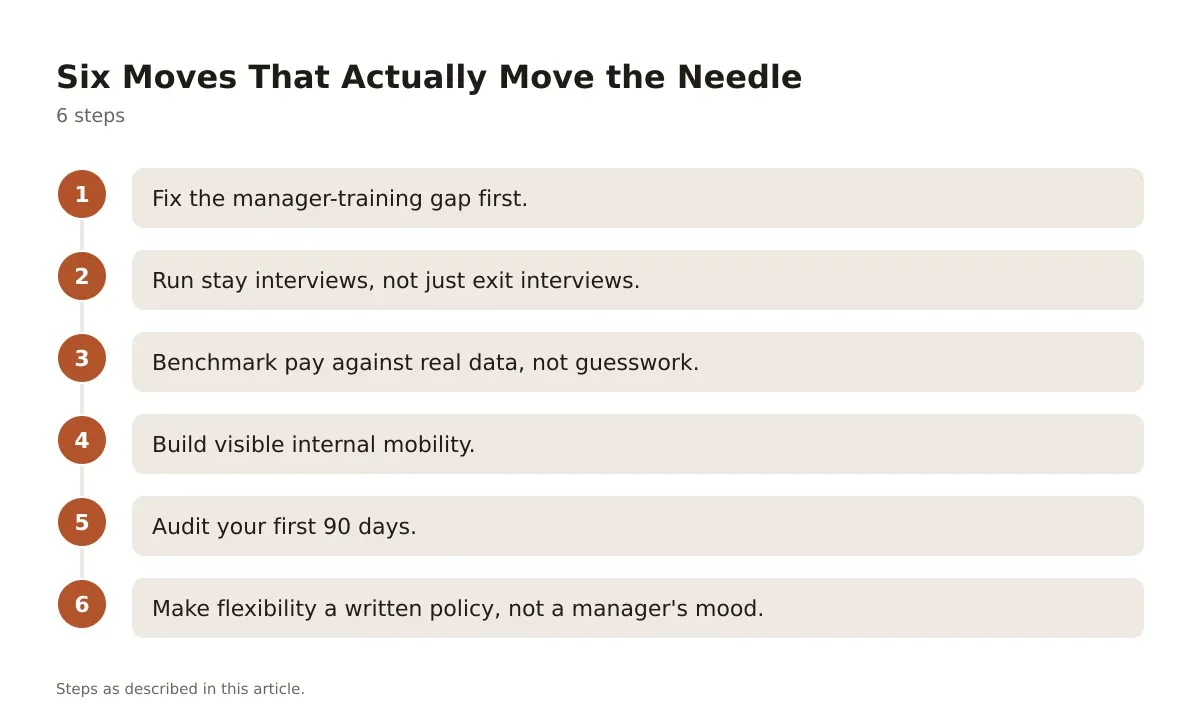
- Fix the manager-training gap first. Give every new manager a structured 90-day onboarding that covers feedback delivery, conflict resolution, and how to run a real one-on-one. Untrained managers are the single biggest predictable driver of regrettable turnover.
- Run stay interviews, not just exit interviews. Ask current employees why they stay, twice a year, using a fixed script (we’ll give you one below). You learn what to protect before you lose it.
- Benchmark pay against real data, not guesswork. Use something like Mercer compensation surveys or regional Bureau of Labor Statistics wage data for your sector, not a gut feeling from the last hire you made.
- Build visible internal mobility. Post internal roles before external ones. Track what percentage of openings get filled internally. If it’s under 20%, you have a growth-stagnation problem.
- Audit your first 90 days. Most voluntary turnover among new hires happens in the first six months. A tight onboarding checklist (below) cuts this dramatically.
- Make flexibility a written policy, not a manager’s mood. Ambiguous remote or hybrid rules create resentment when one manager says yes and another says no to the same request.
None of these require a bigger budget. They require discipline and someone who owns the follow-through.
The Stay Interview Script You Can Use Tomorrow
Stay interviews beat exit interviews for one simple reason: the person is still there, so you can actually act on what they tell you.
Run this twice a year, 20 minutes, same manager or an HR partner if the relationship is tense. Don’t make it a performance review. Keep it separate on the calendar.
Here’s a script that works:
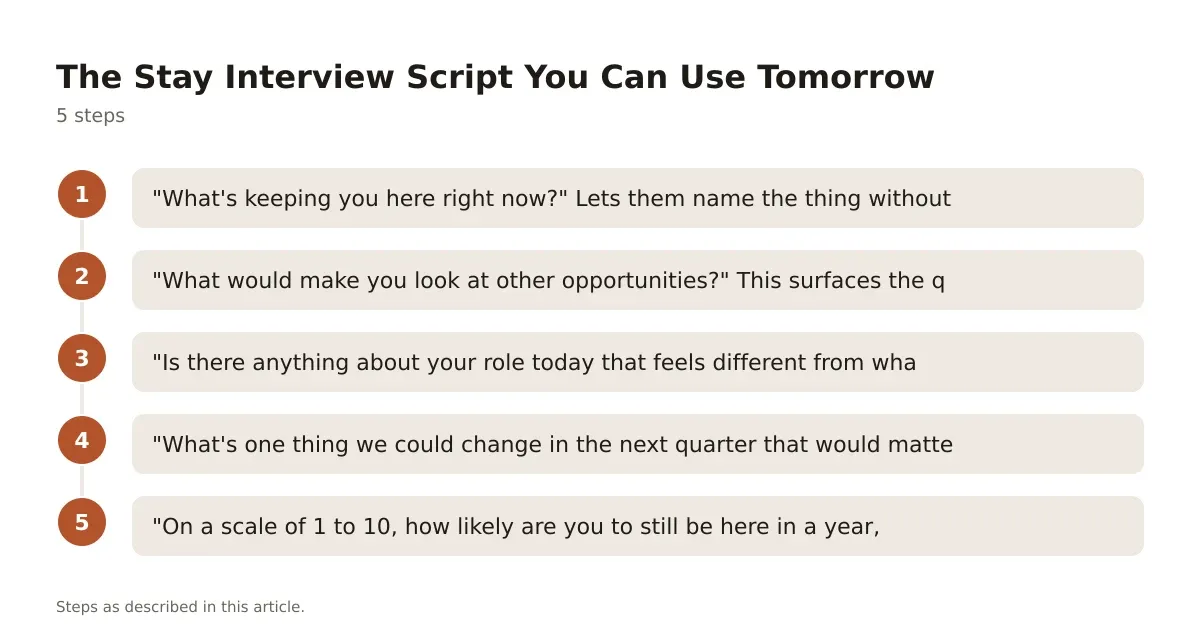
- “What’s keeping you here right now?” Lets them name the thing without you suggesting it first.
- “What would make you look at other opportunities?” This surfaces the quiet risk factors before they become resignation letters.
- “Is there anything about your role today that feels different from what you signed up for?” Catches scope creep and mismatched expectations early.
- “What’s one thing we could change in the next quarter that would matter to you?” Forces a concrete, actionable answer instead of vague feedback.
- “On a scale of 1 to 10, how likely are you to still be here in a year, and why that number?” The “why” matters more than the number itself.
Write the answers down. Review them as a pattern across the team every quarter, not just person by person. If four people independently mention “no path to senior role,” that’s a structural issue, not an individual complaint.
A 90-Day Onboarding Checklist That Cuts Early Turnover
New hires decide whether they made the right choice faster than most companies realize. A disorganized first week tells them everything about how the company actually operates, no matter what the offer letter promised.
Use this checklist, broken into three phases:
Days 1-7
- Equipment and system access ready before day one, not scrambled together that morning
- A named onboarding buddy who isn’t their manager
- A written 30/60/90-day plan shared on day one, not day twenty
- First one-on-one with the manager scheduled before they even start
Days 8-30
- Weekly check-ins with the manager, 15 minutes minimum
- Introduction to at least three cross-functional contacts
- First small project with a visible outcome, something they can point to
Days 31-90
- A formal 90-day conversation covering role clarity, early wins, and friction points
- Manager documents whether the role matches what was promised in the interview
- HR follow-up survey, three questions max, anonymous
Companies that run structured onboarding like this see meaningfully stronger new-hire retention than those relying on an ad hoc “shadow someone for a week” approach, according to onboarding research from the Society for Human Resource Management. The mechanism is simple: clarity early kills the anxiety that turns into a two-month resignation.
Quick Q&A: The Questions HR Leaders Actually Ask
Does a counteroffer ever work? Rarely, and not for long. Data from multiple staffing-industry sources suggests most employees who accept a counteroffer leave within six to twelve months anyway. The underlying reason they looked elsewhere rarely gets fixed by a raise alone.
Should exit interviews still happen? Yes, but treat them as confirmation, not discovery. By the time someone’s resigned, the real issue happened months earlier. Use exit data to validate what your stay interviews already flagged.
What if the real problem is a specific manager? Address it directly and fast. A pattern of resignations from one team, even with average pay, almost always points to management quality, not compensation. Don’t let it sit through another quarter waiting for a “natural fix.”
Is remote flexibility really a retention driver? For many roles, yes. A Pew Research Center 2023 survey of US workers found a large share of remote-capable employees would look for a new job if required back in-office full time. The exact weight depends heavily on sector and role.
Where HR Software Actually Helps (and Where It Doesn’t)
Retention software won’t fix a bad manager culture. But it can catch warning signs faster than a spreadsheet, if you pick the right tool for your size.
| Tool | Starting Price (approx.) | Best fit | Fits badly for |
|---|---|---|---|
| BambooHR | Quote-based, typically per-employee monthly | Companies 20-500 employees wanting onboarding plus HRIS in one | Enterprises needing deep workforce analytics |
| Lattice | Per-employee monthly, tiered by module | Mid-size companies running structured performance and engagement cycles | Very small teams under 20, where it’s overbuilt |
| Culture Amp | Quote-based, scales with headcount | Companies wanting serious engagement and retention analytics | Teams that just want a simple one-on-one tracker |
| 15Five | Per-employee monthly, free trial available | Managers wanting lightweight check-ins and recognition in one place | Large enterprises needing compliance-heavy HRIS features |
Whatever you pick, the tool only works if managers actually use it weekly. A platform full of unopened one-on-one templates is worse than no platform, because leadership assumes the problem is handled when it isn’t. For deeper playbooks on what to do with the data these tools surface, structured approaches to changing retention behavior tend to outperform one-off policy tweaks.
Confirm pricing directly with each vendor before budgeting, since tiers and per-seat costs shift often.
Bringing It Back to the Fundamentals
Improving employee retention isn’t about perks, ping-pong tables, or another engagement platform nobody opens past week two. It’s about fixing the predictable, boring stuff: train managers properly, pay close to market, give people a visible path forward, and ask current employees what’s keeping them around before you lose them.
The companies that get this right treat retention as a management discipline, not an HR initiative bolted onto the side. They run stay interviews on a schedule. They audit onboarding like a process, not a vibe. And when a team’s turnover spikes, they look at the manager first, not the market.
If you’re building out this muscle for the first time, start small. Pick one lever from this article, run it for a quarter, and measure what changes. For teams that want a broader framework on how retention connects to day-to-day engagement work, reworking engagement practices without relying purely on survey data is a logical next read.
Frequently asked questions
How quickly can you expect retention to improve after making changes?
Most structural changes, like manager training or onboarding redesign, take two to three quarters to show up in turnover numbers. Stay interviews can surface fixable issues within weeks, but the underlying culture shift takes longer. Be wary of any consultant promising results in 30 days.
What’s the single biggest predictor of someone quitting in their first year?
Role mismatch between what was described in the interview and what the day-to-day job actually involves. This shows up repeatedly in onboarding research and stay-interview data across sectors. A clear 30/60/90-day plan set on day one is the cheapest way to prevent it.
Should retention targets differ by department?
Yes, almost always. Sales and customer-facing roles typically run higher turnover than engineering or finance in most sectors, so a single company-wide target hides where the real problem sits. Break your turnover data down by team before deciding where to intervene.
Is it legal to pay people differently for the same role based on tenure?
Pay equity rules vary significantly by state and country, and some jurisdictions have specific pay-transparency or equal-pay statutes that affect tenure-based pay gaps. This isn’t something to guess at. Confirm your specific policy with employment counsel before setting any tenure-based pay structure.
Do exit surveys need to be anonymous to get honest answers?
Anonymity generally increases honesty, especially around manager-related complaints, but it also limits your ability to follow up on specifics. Many companies run a hybrid: anonymous for sensitive topics, named for logistics and process feedback. Test both formats and see which gets more actionable detail from your specific workforce.