
You post a job as “hybrid” and get three different reactions. One candidate assumes two office days a week. Another assumes “mostly remote, show up when asked.” A third asks you outright: what does hybrid work mean here? You realize you don’t have a clean answer.
That confusion costs you candidates and causes arguments six months into employment. Let’s fix the definition first, then the policy.
The Actual Definition, Without the Buzzwords
Hybrid work means employees split their working time between a company location and somewhere else, usually home. That’s it. No single ratio defines it, which is exactly why the term causes so much friction.
Some companies run a fixed schedule: three office days, two remote. Others run “anchor days,” where everyone comes in Tuesday and Thursday but floats the rest. Others let managers and teams negotiate their own split entirely, which is really just structured flexibility with a label on it.
The common thread across all versions: it is not full remote, and it is not a return-to-five-days mandate. It’s a deliberate middle position, and the word “hybrid” only becomes useful once you attach a specific pattern to it.
Gartner’s 2026 Hybrid Work research notes that companies using vague hybrid labels without a written cadence see higher attendance disputes than those with a named schedule. The lesson for HR: never ship the word “hybrid” alone in a job post or offer letter. Ship the pattern.
Why the Vague Definition Keeps Causing Problems
Here’s the workplace situation that shows up in almost every HR inbox eventually: a manager tells their team “hybrid, use your judgment,” and three months later one person is in the office daily while another hasn’t been seen since onboarding. Someone complains. Now you’re mediating a fairness dispute that a one-line policy would have prevented.
The root issue is that “hybrid” describes a category, not a commitment. It tells a candidate what it isn’t (fully remote, fully in-office) without telling them what it is. That gap gets filled by assumption, and assumptions don’t survive contact with a calendar.
There’s a second failure mode: policies that specify days but not purpose. Telling people “come in Tuesday and Wednesday” without explaining why trains people to treat office days as compliance theater, not collaboration time. Teams that tie in-office days to specific activities, like sprint planning or client reviews, get far better attendance than teams that just name days on a calendar.
If you want a fuller framework for building the schedule itself, our guide on building a hybrid work schedule walks through the mechanics in more depth than we can cover here.
The Five Hybrid Models You’ll Actually Choose Between
Most companies land on one of five structures. Knowing the names helps you write policy that doesn’t need constant re-explaining.
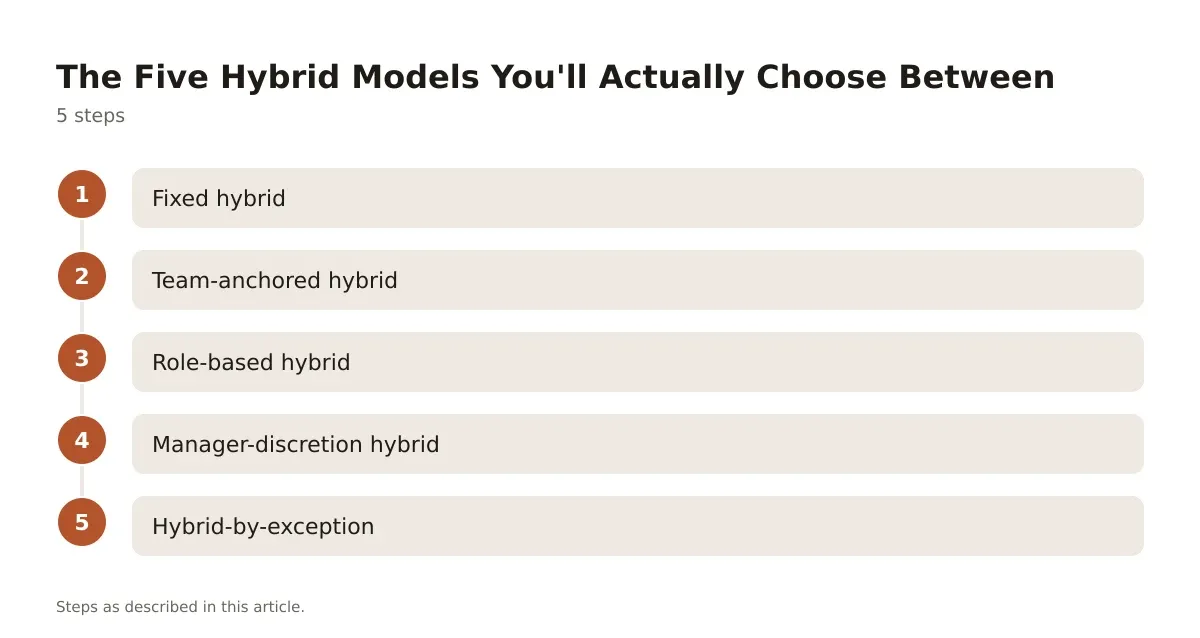
- Fixed hybrid – everyone follows the same schedule, like Monday/Wednesday in-office. Easiest to staff desks and meeting rooms for, hardest to personalize.
- Team-anchored hybrid – each team picks its own in-office days, coordinated so cross-functional meetings still land on overlapping days.
- Role-based hybrid – the split depends on the job. Client-facing sales might be four days in-office; backend engineering might be one.
- Manager-discretion hybrid – leadership sets a minimum (say, two days), and managers decide specifics with their teams.
- Hybrid-by-exception – the default is remote, and office time is scheduled only for specific events like onboarding, planning weeks, or workshops.
None of these is objectively better. A support team handling walk-in clients needs fixed hybrid. A distributed engineering org usually does better with hybrid-by-exception. Pick based on how your work actually gets done, not on what competitors advertise in their job posts.
What to Put in Your Job Posting So Candidates Stop Guessing
Vague hybrid language in job ads is one of the most common sources of early attrition. Here’s wording that removes the ambiguity, copy it directly:
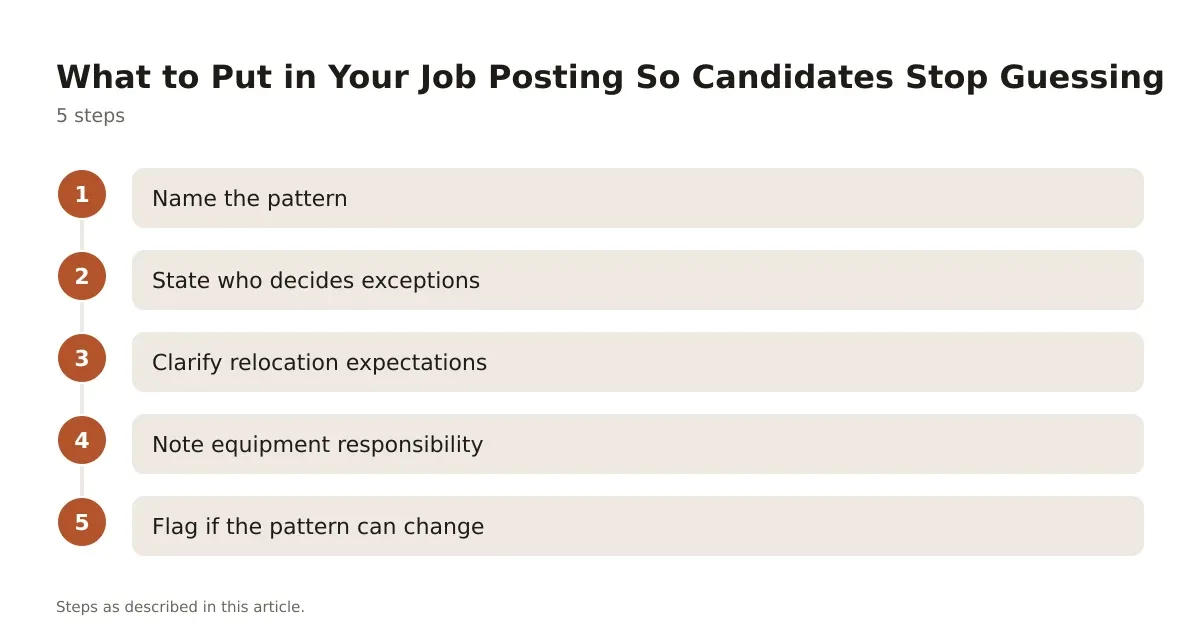
- Name the pattern: “Hybrid – 2 days in our Austin office (Tuesday and Thursday), 3 days remote.”
- State who decides exceptions: “Schedule changes require manager approval with 48 hours’ notice.”
- Clarify relocation expectations: “Candidates must live within commuting distance of Austin; this role does not support relocation.”
- Note equipment responsibility: “Company provides laptop and monitor for home office; no additional stipend.”
- Flag if the pattern can change: “In-office days may shift quarterly based on team needs.”
This isn’t legal boilerplate. It’s the information a candidate needs to decide whether to apply, and the information you need to defend the policy later if someone claims they were misled about expectations.
Quick Q&A: Hybrid vs. Remote vs. Flexible, Settled
Is hybrid just remote work with extra steps? No. Remote work means no fixed office requirement at all. Hybrid always has some in-person component that’s expected, not optional.
Is “flexible work” the same as hybrid? Not quite. Flexible work usually refers to when you work, like flexible start times. Hybrid refers to where you work. A role can be both, neither, or just one.
Does hybrid always mean fewer office days than before the pandemic? Usually, but not always. Some companies that went fully remote during 2020 are now defining “hybrid” as three or four office days, which employees experience as a near-return to the old normal even though it technically meets the hybrid definition.
Can hybrid status affect pay? In some companies, yes, through geographic pay adjustments tied to cost of living. That’s a compensation policy decision separate from the hybrid/remote classification itself, and it varies enough by company and jurisdiction that you should route it through your comp team and legal counsel rather than assume a standard approach.
Writing the Policy Line That Ends the Debate
Once you’ve chosen a model, write it down in language an employee could quote back to you in a dispute. Vague policy language is where most hybrid disagreements start.
A workable policy sentence looks like this: “Employees in the Hybrid-Engineering group work from the Denver office on Tuesdays and Wednesdays, with remote work permitted the remaining three days. Exceptions require written manager approval at least one business day in advance.”
Notice what that sentence does: it names the group it applies to, states the exact days, states the default for the rest of the week, and states the exception process. No employee can reasonably misread that.
Compare it to “Employees are expected to work in a hybrid capacity,” which is the sentence that ends up quoted in HR complaints because it commits to nothing. If your current handbook has language like that, it’s worth an afternoon to rewrite it before it becomes a bigger problem during a disagreement.
One more thing worth confirming with legal counsel: attendance requirements can interact with state-level wage and hour rules, especially around travel time and expense reimbursement for in-office days. Rules differ by state and country, and this article isn’t legal advice. If your hybrid policy requires employees to drive further than their original commute, check with employment counsel in that jurisdiction before finalizing the wording.
Getting Hybrid Definitions Right From Day One
The phrase “hybrid work” will keep meaning five different things until you write down which one applies to your company. That single act, naming the days, naming the exceptions, naming who decides, prevents most of the disputes that land on an HR desk months after a hire starts.
Treat the job posting, the offer letter, and the handbook as three chances to say the same specific thing the same specific way. Candidates read all three. If they don’t match, you’ve created the ambiguity you’re now trying to manage.
Start with the five models above, pick the one that matches how your teams actually collaborate, and write the one-sentence policy format shown earlier. It takes less time than mediating the first fairness complaint, and it sets a tone of clarity that carries into every other flexible-work conversation you’ll have this year.
Frequently asked questions
What does hybrid work mean exactly?
Hybrid work means an employee splits scheduled working time between a company location and another location, typically home, following a pattern the employer defines. The exact ratio varies by company, which is why specifying days and expectations in writing matters more than the label itself.
How many days is considered hybrid work?
There’s no universal standard; two or three office days per week is common, but some companies call four days hybrid and others call one day hybrid. The number only matters if it’s written down somewhere the employee can reference.
Is hybrid work the same as remote work?
No. Remote work has no required in-person component, while hybrid work always includes scheduled office time as part of the arrangement. Someone working “remote-first” with occasional optional office visits is not the same as someone on a fixed hybrid schedule.
Does hybrid work mean I choose my own days?
Sometimes, but not by default. Manager-discretion and team-anchored hybrid models allow choice within limits, while fixed hybrid models set the same days for everyone. Check your specific company policy rather than assuming either structure applies.
Can an employer change hybrid policy after hiring someone?
Employers generally can update workplace policies, but changes affecting pay, commute, or job conditions may carry legal or contractual implications depending on state and country. Confirm any planned changes with employment counsel before rolling them out company-wide.