
Does a ping-pong table count as one of your employee engagement programs? No. Most of what companies call engagement is just perks with a newsletter attached.
Real employee engagement programs change how people are managed day to day: feedback loops, recognition that’s specific, and work that connects to something measurable. If your program could be cancelled tomorrow and nobody would notice, it was never a program. It was decoration.
What Separates Employee Engagement Programs From Perks
A perk is something you hand out. A program has a cadence, an owner, and a way to measure whether it’s working.
Take recognition. A perk version: a Slack channel where managers post “shoutouts” whenever they remember. A program version: every manager runs a 15-minute recognition check-in at the end of each one-on-one, tied to a specific behavior tied to a team goal, logged somewhere searchable like Lattice or a shared doc. One fades after the launch excitement. The other survives a bad quarter.
Here’s a copyable recognition prompt you can hand managers today:
“In our last one-on-one, I want to name one thing you did that moved [specific metric or project] forward. Here’s what I saw, here’s the impact, and here’s how it connects to the team’s goal this quarter.”
That’s four sentences. It takes two minutes to say and it beats a generic “great job” by a mile, because specificity is what makes people believe you actually noticed.
The One-on-One Structure Most Managers Get Wrong
Most managers treat one-on-ones as status updates. Engagement research consistently ties manager relationship quality to retention, but the “status update” format wastes the one lever that works: a recurring, structured conversation about the person, not just the project.
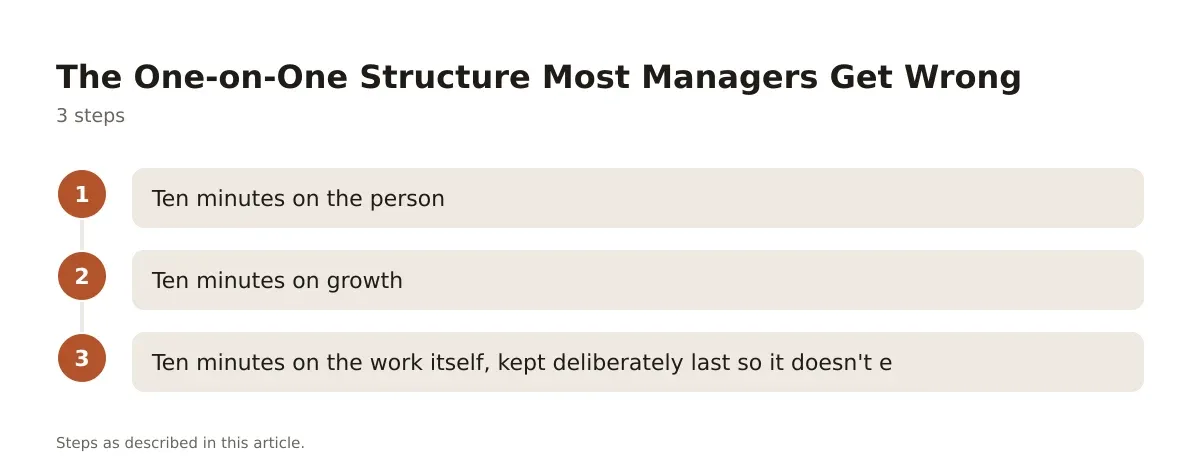
Try this three-part structure, 30 minutes total:
- Ten minutes on the person: energy, blockers, anything outside work affecting focus.
- Ten minutes on growth: one skill they’re building, one piece of feedback either direction.
- Ten minutes on the work itself, kept deliberately last so it doesn’t eat the whole meeting.
Managers who flip this order, work-first instead of person-first, end up with one-on-ones that are indistinguishable from status meetings. That’s the single biggest format mistake we see in engagement rollouts: a good process buried under the wrong order of operations.
If you want a fuller breakdown of which engagement tactics hold up once the initial enthusiasm wears off, employee engagement strategies that hold up under pressure covers the longer-term version of this.
Survey-Led vs Behavior-Led Employee Engagement Programs
Most HR teams default to the survey-led model because it’s easy to launch. But it’s worth comparing the two honestly before you commit a budget line to one.
Option A: Survey-Led Engagement
You run an annual or quarterly engagement survey (Culture Amp, Officevibe, or Microsoft Viva Glint), get an eNPS or engagement score, and build action plans around the lowest-scoring categories.
This works well when leadership needs a number to track over time, and when you have the headcount to actually act on findings. It fits badly in companies under 50 people, where a survey just restates what everyone already said in the hallway, and in fast-growing teams where scores shift every quarter because the headcount itself is shifting. If your last survey had a low completion rate, the data is noise, not a program.
Option B: Behavior-Led Engagement
Here you skip the big annual instrument and instead instrument the behaviors directly: one-on-one cadence, recognition frequency, manager response time on feedback, promotion velocity. You track inputs, not just sentiment.
This fits companies that already have strong people-ops habits and want to catch problems before they show up in a survey six months later. It fits badly in organizations with no manager training budget, because behavior-led programs live or die on manager execution, and untrained managers will not run a good one-on-one just because you asked them to.
Most mature programs end up running both: a lighter-touch pulse survey (not an annual marathon) alongside behavior tracking. If you’re deciding whether to drop the survey altogether, employee engagement survey: what actually works walks through when pulse formats beat annual ones.
Five Employee Engagement Programs Worth Building First
Not every engagement idea deserves a line item. These five tend to earn their keep because they’re cheap to run and the effect is visible within a quarter.
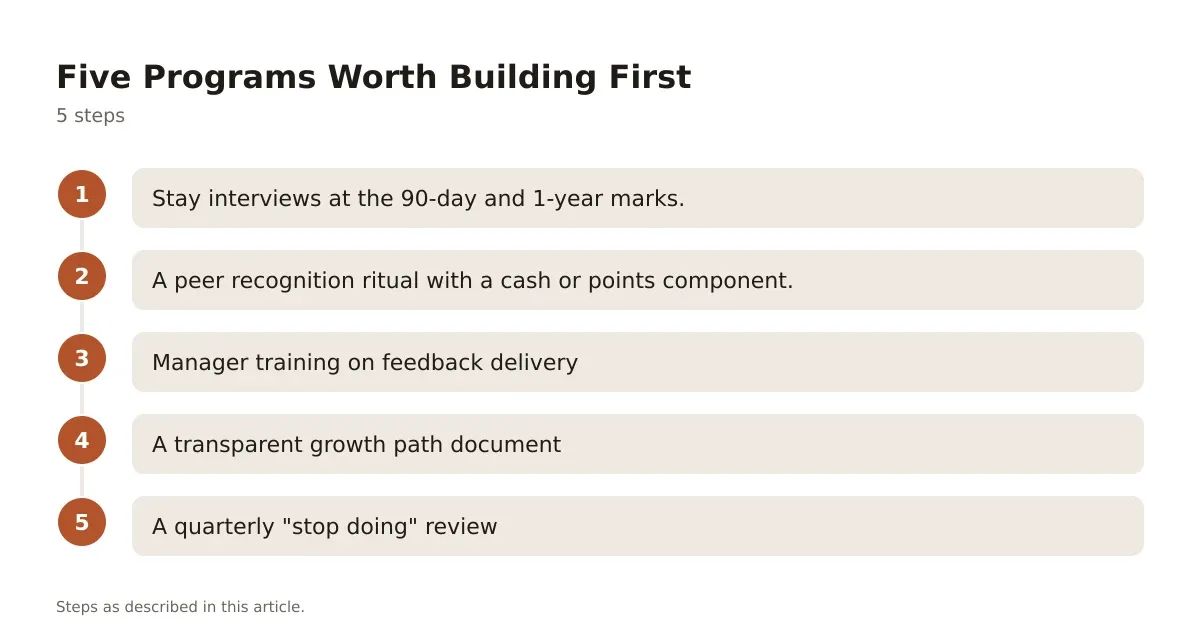
- Stay interviews at the 90-day and 1-year marks. Ask directly: “What would make you look for another job?” and “What’s one thing we could change this month?” Document answers and revisit them at the next check-in.
- A peer recognition ritual with a cash or points component. Platforms like Bonusly or Nectar work because the recognition is specific and small amounts land often, not because the dollar value is large.
- Manager training on feedback delivery, even a half-day workshop, because most engagement failures trace back to untrained managers, not bad employees.
- A transparent growth path document showing what skills or outcomes move someone to the next level, shared before the performance review, not during it.
- A quarterly “stop doing” review, where teams name one process or meeting to kill. Low cost, high signal, and it tells employees their time is respected.
None of these need a big platform purchase to start. You can run the first three with a spreadsheet and a calendar invite.
Where Employee Engagement Programs Waste Budget
The common failure pattern: a company buys an engagement platform before fixing the manager layer underneath it.
Software can log recognition, run pulse surveys, and flag flight-risk scores. It cannot make a manager show up prepared to a one-on-one. If your managers skip one-on-ones half the time, no tool fixes that; you need a manager accountability structure first; the software comes after.
A second common waste: running engagement surveys with no action plan attached. According to Gallup’s State of the Global Workplace report, global employee engagement has hovered in a narrow band for years, and Gallup’s own analysis repeatedly points to manager quality as the dominant variable, not survey frequency. If you survey people and change nothing visible within 60 days, you’ve taught them the survey is theater. That’s worse than not asking.
If budget is the real constraint, pick the cheapest three items from the list above before buying any software. You’ll learn more about what’s actually broken from running a manager one-on-one audit than from a six-figure platform license.
Rolling a New Program Out Without Losing the Team
Launch matters as much as design. A good program announced badly reads as another initiative nobody asked for.
Keep the announcement specific and short. Something like: “Starting next month, every manager will run a structured 30-minute one-on-one weekly, using this format [link]. We’re tracking completion, not content, your conversations stay private.” That tells people what changes, what’s measured, and what isn’t surveilled.
Give it one full quarter before judging results. Engagement shifts slowly; a single bad month doesn’t mean the program failed, and a single good month doesn’t mean it worked. If you’re building the rollout plan and want more ideas for what to put inside it, employee engagement ideas for 2026: what actually moves the needle has a longer list to pull from. And if you’d rather skip the survey-heavy approach entirely and build around behavior instead, how to improve employee engagement without a survey fetish lays out that path in more detail.
Employee Engagement Programs That Survive Past the Launch
The programs that last share three traits: a named owner, a cadence that doesn’t depend on enthusiasm, and a measure simple enough that a skeptical CFO can understand it in one sentence.
Skip the platform shopping until the manager behaviors are in place. A $4-per-employee-per-month recognition tool bolted onto untrained managers will produce exactly the engagement data you’d expect: flat, or worse, declining, because the tool surfaces problems it can’t fix.
Start with one-on-ones, stay interviews, and specific recognition. Add measurement once those habits exist, not before. That order is the whole difference between an employee engagement program that changes behavior and one that just adds another dashboard nobody opens.
Frequently asked questions
How do you measure whether an employee engagement program is working?
Track behaviors, not just sentiment: one-on-one completion rate, recognition frequency, voluntary turnover in the first year, and internal promotion rate. Pair those with a short pulse survey, three to five questions, run quarterly rather than annually. If the behaviors improve but the survey score doesn’t move for two quarters, dig into whether the survey questions match what you’re actually changing.
What’s a reasonable budget for an employee engagement program?
It depends heavily on headcount and whether you’re buying software. Many recognition and pulse-survey tools price per employee per month, often in the low single digits to around ten dollars, though you should confirm current pricing directly with each vendor since it changes often. The cheapest effective programs, stay interviews and structured one-on-ones, cost staff time, not software spend.
Do small companies need a formal engagement program?
Formal, no. Structured, yes. A 20-person company doesn’t need an annual survey cycle, but it does need a consistent one-on-one cadence and a clear way for people to raise concerns before they quit. Skipping structure because you’re small is how small companies get blindsided by resignations that looked sudden but weren’t.
Can engagement programs create legal risk?
Yes, particularly around how feedback, performance data, and recognition decisions are documented and used in promotion or termination decisions. Rules on recordkeeping, pay transparency tied to performance programs, and data privacy vary by state and country. Confirm specifics with employment counsel before rolling out anything that ties engagement data to compensation or disciplinary action.
Which engagement software fits a growing team best?
It depends on what you’re trying to fix first. If manager behavior is the gap, look at tools built around one-on-one tracking and feedback prompts rather than survey dashboards; a fuller comparison of what each tool actually changes is in employee engagement tools that actually change behavior. Match the tool to the behavior you’re short on, not the other way around.