
Only 29% of HR leaders say their organization has a formal workforce plan tied to business strategy, according to a Gartner survey of HR executives. Strategic workforce planning closes that gap. Most companies still hire reactively, filling seats after someone quits rather than mapping headcount against where the business is actually going.
Strategic workforce planning fixes that gap. It means forecasting the skills, roles, and headcount you’ll need 12 to 36 months out, then building the hiring, training, and budget plan to get there. Done well, it turns HR from a request-taker into a function that shapes the business.
What Strategic Workforce Planning Actually Involves
Strategic workforce planning connects three things: your business plan, your current headcount, and the gap between them.
Start with the business plan. If revenue targets assume a new product line launching in Q3, someone needs to ask what roles that requires. Engineering? Customer support in a new language? A regional sales lead? Too often, that question gets asked in week two of the launch, not six months before it.
Next comes a skills inventory. You need to know what capabilities already exist inside the company, not just job titles. A software engineer with three years of machine learning experience is a different asset than one who’s never touched it, even if both have the same title and pay band.
Then you map the gap. Where you’re short, you decide: hire, train, redeploy, or contract. That decision should happen on paper, with a timeline, not in a Slack thread after someone escalates a staffing complaint.
Building Your Workforce Plan: A Template You Can Copy
Here’s a structure you can lift directly into a spreadsheet or Google Sheets template. Run it quarterly for fast-growing teams, twice a year for stable ones.
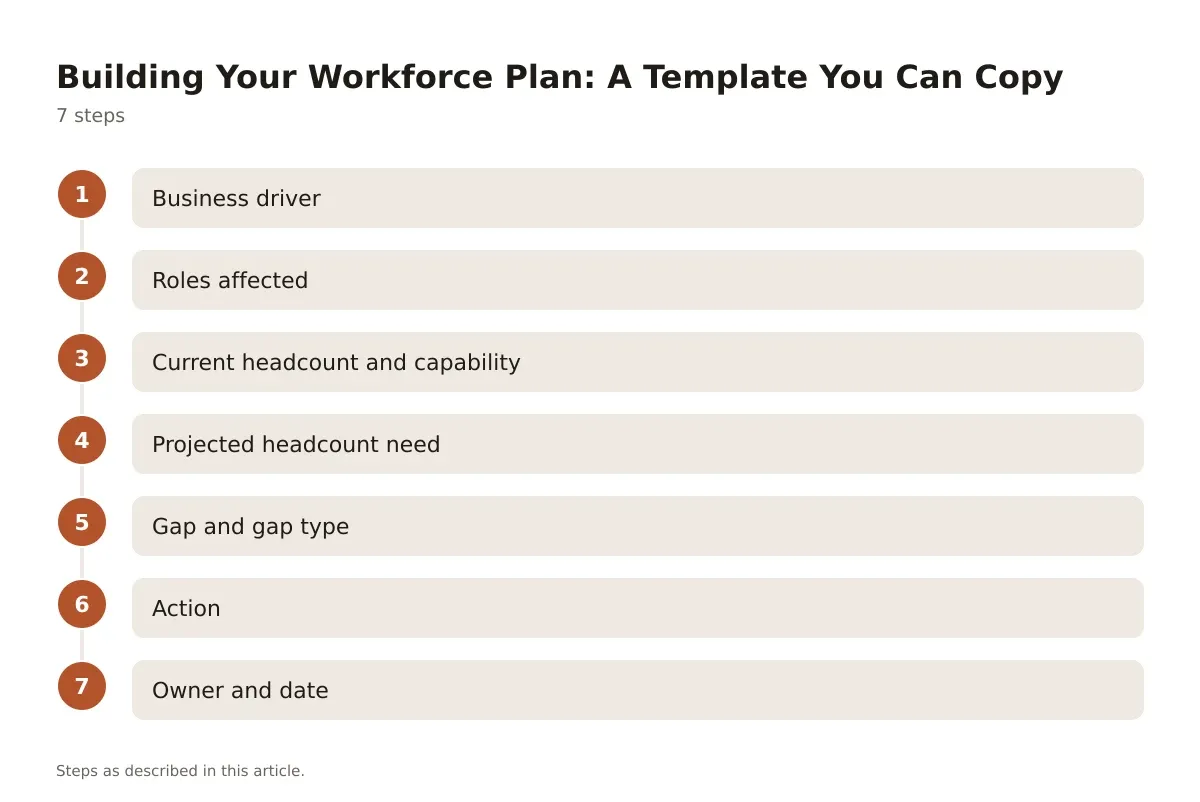
- Business driver: What’s changing in the next 12 months? (new market, product launch, cost reduction, merger)
- Roles affected: List every function touched, not just the obvious ones. A new market often means legal and finance headcount too.
- Current headcount and capability: Pull actual numbers from your HRIS, not estimates.
- Projected headcount need: Low, medium, high scenario, tied to revenue or volume assumptions.
- Gap and gap type: Shortage, surplus, or skills mismatch.
- Action: Hire, upskill, redeploy, contract, or attrition-manage.
- Owner and date: Who’s accountable, and by when.
Fill this out with actual department heads in the room, not just HR guessing at their needs. A finance director who knows headcount costs 60-70% of operating budget in most services businesses will have sharper instincts about sustainable hiring pace than an HR generalist working from a hiring request form.
Forecasting Headcount Without Guessing
The hardest part of strategic workforce planning is the forecast itself. Most teams either overcomplicate it with statistical models nobody trusts, or skip it entirely and just extrapolate last year’s headcount growth.
A workable middle ground: build three scenarios (conservative, base, aggressive) tied to a single business metric that actually drives headcount in your company. For a SaaS company, that might be net new ARR. For a logistics company, it might be shipment volume.
Say your base case assumes 20% revenue growth and your current revenue-per-employee ratio is $180,000. That implies headcount should grow roughly in step with revenue, unless you’re banking on productivity gains from new tooling or process changes. Name that assumption explicitly. If you’re assuming AI tools will cut support headcount growth by half, write that down and revisit it quarterly against actual ticket volume per agent.
Tools like Visier and ChartHop can automate some of this by pulling live HRIS data into scenario models. Visier is quote-based and built for larger enterprises with messy, multi-system HR data; it’s overkill and expensive-feeling for a 50-person company. ChartHop fits mid-market teams better and has more approachable org-chart-first planning views, but smaller teams often get just as far with a well-built spreadsheet and a disciplined quarterly review.
Skills Gap Analysis That Managers Will Actually Use
A skills gap analysis dies when it becomes a 40-question self-assessment survey nobody wants to fill out honestly.
Keep it simpler. Ask each manager three questions about their team, once a quarter:
- Which skills on this team are critical but held by only one person?
- Which skills will this role need in 12 months that it doesn’t need today?
- Where would losing someone this quarter actually stall a project?
That third question surfaces single points of failure fast. If a manager says “if Priya leaves, nobody else can run payroll reconciliation,” that’s not a retention nice-to-have, that’s an operational risk with a name attached to it.
Document answers in a shared tracker, review them alongside turnover data, and flag the roles where gap and flight risk overlap. Those are your training or backfill priorities, not every role equally.
Pro tip: pair skills gap findings with your engagement survey results. A skill gap combined with low engagement in that same team is a much stronger signal than either one alone.
Succession Planning and Internal Mobility
Succession planning used to mean a confidential list of three names for the CEO’s job, discussed once a year by the board. That’s still worth doing for the top two tiers of leadership, but strategic workforce planning treats succession more broadly, as a pipeline question for every critical role.
Ask, for each role flagged as critical in your skills gap work: if this person left tomorrow, who could step in within 90 days, and who could step in within a year with development?
Write real succession plans, not vague ones. Here’s phrasing you can use in a succession review document:
“Role: Regional Operations Manager, East. Ready now: none identified. Ready in 12 months: Marcus T. (needs budget ownership experience, currently shadowing on Q3 planning). Ready in 24 months: Elena R. (needs cross-functional exposure, recommend rotation into supply chain for two quarters).”
That level of specificity forces a development conversation instead of a wish list. Internal mobility data backs this up: LinkedIn’s Workplace Learning Report (2024 edition) found employees stay almost twice as long at companies with high internal hiring rates. Treat internal mobility as a retention lever, not a nice-to-have HR program.
Choosing Workforce Planning Software
Visier
Visier is built for large, complex organizations with multiple HRIS systems and a dedicated people analytics team to run it. Pricing is quote-based and tends to land in enterprise territory. It fits badly for companies under 500 employees, where the implementation lift outweighs the payoff.
ChartHop
ChartHop combines org charting with headcount planning and is priced per employee, with published starting tiers aimed at mid-market companies. It fits badly for very early-stage startups still figuring out their org structure month to month, since the planning features assume some baseline stability.
Workday Adaptive Planning
Workday Adaptive Planning extends financial planning into workforce scenarios and works well for companies already on Workday HCM, since the data connection is native. It fits badly as a standalone tool for companies not already in the Workday ecosystem; the integration tax isn’t worth it otherwise.
Spreadsheets (Google Sheets or Excel)
A well-structured spreadsheet template, rebuilt quarterly, remains the right tool for companies under roughly 150 employees. It fits badly once you have more than a handful of business units or need real-time headcount data pulled automatically from your HRIS.
| Tool | Best fit | Pricing model | Fits badly for |
|---|---|---|---|
| Visier | Large enterprise, multi-system HR | Quote-based | Companies under 500 employees |
| ChartHop | Mid-market, org-chart-first planning | Per-employee, tiered | Very early-stage startups |
| Workday Adaptive Planning | Existing Workday HCM customers | Quote-based | Companies outside Workday ecosystem |
| Spreadsheets | Small companies, simple org structure | Free (Google Sheets) or licensed (Excel) | Multi-business-unit, fast-scaling teams |
Before you commit budget to any platform, confirm current pricing directly with the vendor. Published tiers shift often, and per-employee costs usually depend on headcount bands and contract length.
Making the Plan Stick
A workforce plan that sits in a slide deck from the Q1 offsite is worse than no plan at all, because it creates false confidence.
Review it quarterly, not annually. Business assumptions change faster than that, especially at companies under 500 employees where one lost contract or one funding round can reshape the hiring plan overnight. Put the review on the same calendar cadence as your financial forecast review, ideally the same meeting, so headcount and budget get discussed together instead of in separate silos.
Assign one owner for the overall plan, usually the senior HR or people-ops leader, even though individual sections get input from finance and department heads. Shared ownership across too many people usually means nobody updates it.
One honest caveat worth naming here: strategic workforce planning works best in companies with at least some predictability in their business model. Early-stage startups pivoting every quarter will get less value from a 24-month headcount model and more value from a tighter, 2-quarter rolling plan reviewed monthly. Match the planning horizon to how fast your business actually changes, not to what looks thorough on paper.
Employment law touches almost every action item a workforce plan generates, from restructuring to redeployment to contractor classification. Rules on notice periods, redundancy consultation, and worker classification differ significantly by state and country, and get updated often. Confirm specifics with employment counsel before acting on any workforce plan that involves role eliminations, reclassifications, or cross-border hiring.
Frequently asked questions
How often should we update our strategic workforce plan?
Quarterly works for most growing companies, tied to the same cadence as financial forecasting. Stable, low-growth organizations can often get away with a twice-yearly review. Any major business event, like a funding round, acquisition, or large contract loss, should trigger an off-cycle update regardless of your normal schedule.
Who should own strategic workforce planning inside a company?
Usually the senior HR or people-ops leader owns the overall document and process, but it only works with real input from finance and department heads. Finance brings the budget constraints and revenue assumptions; department heads know which skills and roles actually drive their team’s output. Treat it as a shared planning exercise, not an HR-only deliverable.
What’s the difference between workforce planning and succession planning?
Succession planning is one piece of the broader workforce planning picture, focused specifically on who could step into critical roles if someone leaves. Strategic workforce planning is the wider exercise: forecasting total headcount needs, identifying skills gaps, and deciding how to close them through hiring, training, or redeployment. Most mature HR functions run succession planning as a subset of their annual or quarterly workforce review.
Do small companies need strategic workforce planning, or is it only for large enterprises?
Small companies need it too, just in a lighter form. A 40-person company doesn’t need Visier or a 36-month scenario model; a quarterly spreadsheet review tied to revenue targets covers most of the value. The core discipline, which is forecasting needs before you’re in a hiring crisis, matters at any headcount.
How does strategic workforce planning relate to DEI and hiring goals?
Workforce planning is where DEI goals should get built into hiring targets from the start, rather than bolted on after a requisition is already posted. If your plan shows you’re opening 15 new engineering roles next year, that’s the moment to set sourcing and interview panel diversity targets, not after the first ten hires are made. Build those targets into the “action” column of your workforce plan template so they’re tracked alongside headcount, not as a separate initiative.
Planning headcount only pays off if people stay, so it is worth reading this with our guide on how to improve employee retention.