
Most people write self-reviews like they’re apologizing for existing. That’s backwards. Writing a performance review for yourself is a negotiation document in disguise.
Here’s the direct version: writing a performance review for yourself examples should show should quantify impact, name specific wins, and own the misses without groveling. Below you’ll find the phrasing, structure, and actual language that gets self-reviews read instead of skimmed.
Why Writing a Performance Review for Yourself Gets Ignored by Managers
Managers skim self-reviews in under two minutes. That’s the uncomfortable truth.
A manager with eight direct reports is reading eight self-assessments the same week they’re writing eight reviews themselves. If your write-up is vague (“I worked hard on the Q3 project and contributed to team success”), it gets a mental shrug and a generic rating.
What gets read twice is specificity. “Reduced onboarding time for new sales reps from 19 days to 11 days by rebuilding the training deck” tells a manager exactly what to copy into the calibration meeting. You’re not just writing for yourself. You’re writing your manager’s talking points for them.
This matters more at companies using calibration sessions, where managers defend ratings in front of other managers. A self-review with hard numbers gives your manager ammunition. A vague one gives them nothing to work with, and nothing to work with usually defaults to a middle-of-the-road score.
The Structure for Writing a Performance Review That Gets Read
Skip the five-paragraph essay format. Use sections a skimmer can scan in order.
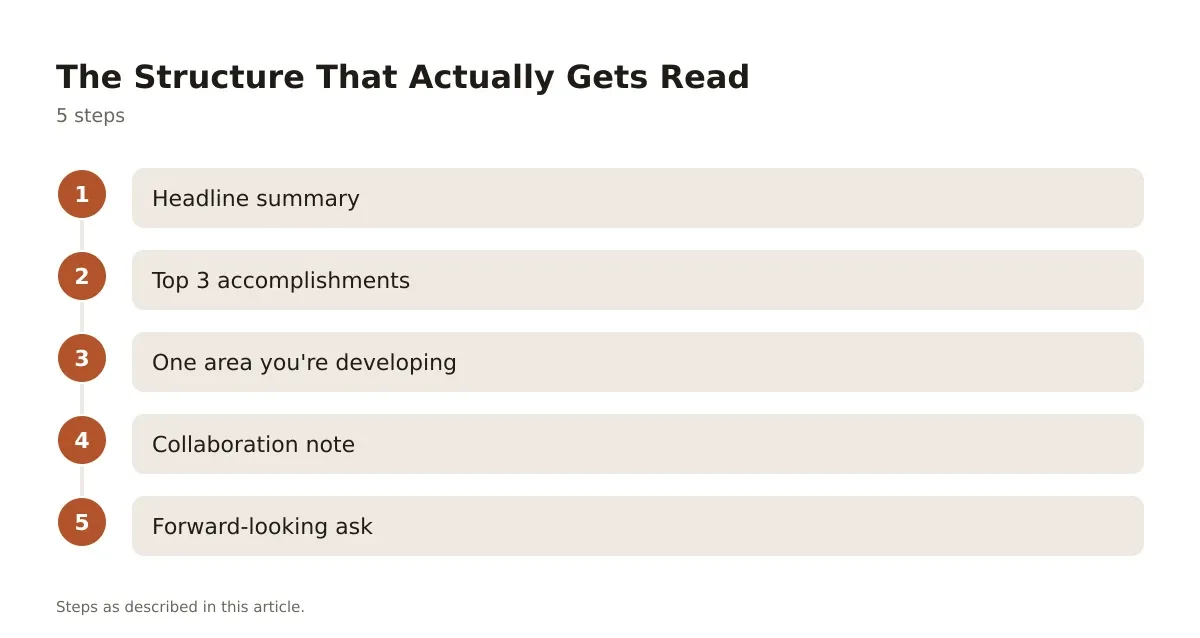
- Headline summary – two sentences on your overall contribution this period.
- Top 3 accomplishments – each with a number, a before/after, or a named outcome.
- One area you’re developing – framed as action, not confession.
- Collaboration note – one line on how you supported peers or cross-functional work.
- Forward-looking ask – what you want to own, learn, or be considered for next cycle.
That’s five sections, and each one should run three to five sentences max. Managers reward brevity because it respects their time, and it signals you can self-edit, which is itself a competency most companies claim to value and almost never score explicitly.
If your company uses a rigid form with required fields, adapt this structure inside those boxes rather than abandoning it. The order matters less than the discipline: lead with outcomes, not activities.
Accomplishment Phrasing for Writing a Performance Review
This is the part people actually search for. Here’s phrasing organized by job function, written so you can swap in your own numbers.
For individual contributors in operations or support roles:
“Resolved an average of 47 support tickets weekly, 12% above team target, while maintaining a customer satisfaction score of 94%.”
“Identified a recurring billing error affecting roughly 200 accounts and built a fix that cut related tickets by 60% within one month.”
For sales or account management:
“Closed $340,000 in new business against a $280,000 quota, with three of five deals in previously untouched verticals.”
“Reduced customer churn on my book of business from 14% to 9% by introducing quarterly check-in calls.”
For engineering or technical roles:
“Shipped the notification service redesign two weeks ahead of schedule, cutting average delivery latency from 800ms to 210ms.”
“Fixed 23 production bugs flagged as high-severity, reducing the open bug backlog by one-third.”
For marketing or content roles:
“Grew organic traffic to the resource hub by 38% quarter over quarter through a content refresh of 40 underperforming pages.”
Notice none of these use the word “helped” or “assisted.” They use verbs that claim ownership: built, closed, reduced, shipped, fixed, grew. If you genuinely played a supporting role, say “partnered with” or “co-led,” but don’t default to passive language when you drove the outcome yourself.
Framing Weaknesses When Writing a Performance Review
Nobody believes a self-review with zero flaws. Reviewers read that as either dishonest or self-unaware, and both read badly.
The trick is choosing a development area that’s real but not disqualifying, and pairing it with the action you’ve already taken. Compare these two versions of the same admission:
Weak: “I need to work on my public speaking because I get nervous in big meetings.”
Strong: “Presenting to groups larger than 15 people is still a growth area for me. I signed up for the internal presentation skills workshop in Q2 and have since led two all-hands updates for my pod.”
The second version names the gap, shows you already acted on it, and gives a measurable next step. That’s the difference between confessing a flaw and managing one.
Avoid naming a weakness that’s actually core to your role. If you’re a project manager, don’t write “I struggle with deadlines.” Pick something adjacent and genuinely developmental: a tool you’re still learning, a skill you’re building toward a promotion, or feedback you got once and are actively addressing. If you want more worked examples across different job levels, the areas of improvement performance review examples breakdown has a wider range of phrasing to pull from.
Writing a Performance Review After a Real Setback
Here’s a situation almost every employee hits eventually: the review period includes a missed deadline, a dropped project, or a visible mistake. Pretending it didn’t happen is worse than addressing it, because your manager already knows.
Say you missed a launch date by three weeks because a vendor integration broke late in testing. Don’t bury it or over-explain it. Write something like:
“The Q3 product launch shipped three weeks behind the original date due to a vendor API issue discovered during final testing. I escalated within 48 hours, coordinated a workaround with engineering, and we launched with zero post-release critical bugs, compared to the typical two to three we see on schedule.”
This does three things: states the fact plainly, shows the response was fast and proportional, and reframes the ending as a quality win instead of just a delay. You’re not spinning a failure into a fake success. You’re showing judgment under a real constraint, which is often what managers are actually evaluating.
If the setback was more clearly your error, the format changes slightly, but the principle holds: name it, name what you changed because of it, and move on without three paragraphs of self-flagellation. One sentence of accountability is enough. More than that reads as fishing for reassurance.
Common Mistakes in Writing a Performance Review
Even people with genuinely good years sabotage their own self-review. A few patterns show up constantly.
Mistake 1: Listing activities instead of outcomes
“Attended 40 client meetings” is an activity. “Attended 40 client meetings, converting 12 into expansion revenue worth $90,000” is an outcome. Managers rate outcomes.
Mistake 2: Underselling because of imposter syndrome
Many strong performers round their wins down out of discomfort with self-promotion. If you genuinely cut a process from six steps to two, say six steps to two. Don’t write “streamlined slightly.”
Mistake 3: Copying last year’s language
Reviewers notice recycled phrasing, especially managers who’ve read your reviews for multiple cycles. New period, new specifics, even if the role hasn’t changed much.
Mistake 4: Ignoring the forward-looking section
A self-review that only looks backward wastes a chance to shape next year’s goals. End with a specific ask: a stretch project, a skill you want funded, or a scope expansion you’re ready for.
Mistake 5: Matching tone to mood instead of evidence
If you had a rough final quarter, don’t let that color your description of a strong first half. Review the whole period, not just what’s fresh in memory. Pulling up old project trackers, Slack threads, or a running “brag document” before you write solves this instantly.
If your company’s full review cycle feels overwhelming to prepare for on both sides, the broader performance review season guide walks through the calendar end to end, not just the self-assessment piece.
Turning Your Draft Into the Final Submission
Once you’ve got the content, the final pass matters almost as much as the writing itself.
Read it out loud once. Self-reviews written in one sitting often have run-on sentences that sounded fine in your head but stall on the page. Cut anything that takes two reads to understand.
Match your numbers to what your manager can verify. If you claim a 38% traffic increase, make sure that number exists in Google Analytics or whatever dashboard your team uses, because a manager who spot-checks and finds a mismatch will discount everything else you wrote. Consistency between your claims and the system of record builds trust for every future review cycle.
Finally, keep a copy outside the HR system. Export it or paste it into a personal doc. You’ll want it again in six months when you’re updating your resume or prepping for a job search, and most HR platforms don’t make old review text easy to retrieve later. For a fuller walkthrough of self-review structure and more copy-paste phrasing by scenario, the self performance review examples guide pairs well with everything above.
Getting It Done Without Overthinking It
A self-review is not a personality test. It’s a short document with one job: make your contribution legible to someone who didn’t watch you do the work day to day.
The formula holds across industries and seniority levels. Lead with outcomes, back every claim with a number or a named result, own one real development area with a visible next step, and close with what you want next. Skip the apology tone. Skip the padding. If you keep a running list of wins throughout the year instead of reconstructing them from memory in review week, this entire process gets easier every single cycle.
Once you’ve drafted your own review, it’s worth checking it against the format your manager will be using on their end, since mismatched structure is one more reason reviews feel disconnected from each other.
Frequently asked questions
How long should a self-performance review be?
Most effective self-reviews run 400 to 700 words, organized into short sections rather than long paragraphs. Length matters less than density: a tight 500-word review with specific numbers beats a rambling 1,200-word one. If your company’s form has required fields, aim for three to five sentences per field rather than filling space for its own sake.
Should I give myself a numeric rating if the form asks for one?
Rate yourself honestly against the stated criteria, slightly favoring your actual results over modesty. Most calibration processes adjust scores anyway, so an inflated self-rating with weak evidence looks worse than an accurate one backed by specifics. If you’re unsure how your company’s rating scale maps to outcomes, ask your manager or HR for the rubric before you submit.
What if I genuinely had a weak review period?
Focus on what you controlled and what you learned, rather than inflating weak results. Name one or two real contributions, be honest about the gap between expectation and output, and spend more space on your plan for the next period than on justifying the last one. Managers generally respect a candid, forward-looking self-review more than a defensive one.
Can I use the same self-review template every cycle?
You can reuse the structure, but never the content. The five-section format (summary, top accomplishments, development area, collaboration, forward ask) works every cycle because it’s a skeleton, not a script. Refresh every example, number, and development area each time, since recycled language is one of the fastest ways reviewers tune out.
How do I handle a self-review if my manager changed mid-year?
Write for the manager who will be reading it now, even if they weren’t there for the earlier months. Include brief context for accomplishments from before they joined your team, since they may not have visibility into that period. A short note like “prior to Q2, under [previous manager], I also delivered X” keeps the record accurate without assuming shared history.